
Psychologist’s Guide to Spiritual Awakening: Meaning, Stages and What No One Tells You
Written by Kirsti Formoso, MSc. Transpersonal Psychology, BSc. Psychology
Spiritual awakening rarely begins with clarity.
More often, it begins as a quiet destabilisation, a sense that the way you’ve understood yourself, others, or reality no longer quite holds.
You might notice heightened sensitivity, changes in perception, or a growing intuition that life is more complex than the framework you were given. Old identities can loosen. Relationships may feel misaligned. Familiar goals lose their charge. At the same time, a deeper curiosity, sometimes accompanied by confusion or longing, starts to emerge.
WHAT IS SPIRITUAL AWAKENING?
Spiritual awakening is a sudden or gradual opening in awareness in which you begin to see the world differently. Something shifts in how you perceive yourself and reality. Psychologically, it's not a symptom to manage; it's what happens when the mental frameworks holding your sense of self loosen enough for something more direct to come through. You start to recognise your true nature beyond the conditioned mind and ego. You realise you are not just your thoughts, roles, or identity, but a more fundamental and expansive interconnected consciousness. This insight often brings clarity, peace, and a sense of meaning that feels more authentic than the stories you previously lived from.
THE PSYCHOLOGY OF SPIRITUAL AWAKENING
Early psychologists, such as William James, explored spiritual awakening as a meaningful aspect of human life. In The Varieties of Religious Experience, James approached spiritual and mystical experiences not as pathology, but as psychologically significant shifts in perception, meaning, and identity. As one of the founding figures of modern psychology, James encouraged psychologists to study and explore this phenomenon.
Relatively few psychologists took James’ lead, but the candle has been kept alight, and today we know much more about spiritual awakening and the experiences that lead to it. Firstly, we know that these experiences are far more common than many people realise and, while they can be destabilising, psychology shows they are not in themselves signs of mental illness.
On the contrary, at the John Hopkins Center of Psychedelic and Consciousness Research, spiritual and mystical experiences are considered to be the nexus of the therapeutic effect. What’s more, research participants rate their experiences as amongst the most significantly meaningful experiences of their lives. What makes these experiences so meaningful and therapeutically potent appears to be a fundamental shift in how consciousness itself is structured during the experience.
From a neuro-psychological perspective, spiritual awakening can be understood as a rupture in your cognitive, perceptual and sensory systems, allowing awareness to be experienced directly rather than through its usual interpretive filters (de Castro, 2015). This is the profound shift in awareness we experience when we awaken spiritually.
SPIRITUAL AWAKENING MAPPED IN PSYCHOLOGY
Within spiritual communities and certain psychological disciplines, it is widely accepted that while spiritual and mystical experiences serve as a launchpad for spiritual awakening, it is the integration of these experiences that leads to lasting transformation and deeper awakening.
In this way, psychologists approach spiritual awakening not as a sudden or inexplicable event but as a developmental process that continually unfolds and evolves as we integrate new insights and experiences. Spiritual seekers call this process the spiritual journey.
Transpersonal psychology, a field of psychology that explores the relationship between mind and spirit, builds on developmental understanding and maps the inner journey of transformation. Drawing on the work of Abraham Maslow, transpersonal psychology recognises that human development can extend beyond self-actualisation into what Maslow described as self-transcendence, in which the sense of self expands beyond the personal ego. Since Maslow, researchers and practitioners have observed common patterns, stages, signs, and triggers that guide this process of spiritual awakening.
While transpersonal psychology offers a framework for understanding this developmental process, traditional psychology has often overlooked these profound experiences of transformation. As a result, some people are left wondering if there is something wrong with them, when in reality they may be undergoing a recognised and meaningful aspect of psychological development.
MY EXPERIENCE OF SPIRITUAL AWAKENING
As a transpersonal psychologist, I’ve spent decades exploring spiritual awakening both personally and professionally. I’ve been on a spiritual path for around 30 years, have experienced several spiritual awakenings, and have lived in a non-dual state of consciousness for an extended period.
Through these lived experiences, my academic training, and my work with clients, I’ve come to see spiritual awakening as a deeply personal and meaningful journey back to a more fundamental sense of self and reality. It is as if we wake up from the egoic sleep that has kept us trapped in our little me stories, beliefs, and perceived limitations.
During one of my own profound awakenings, I witnessed the gradual process of returning to ordinary egoic functioning. This period gave me a deep understanding of the tension that can arise between egoic identity and more expansive states of consciousness. I was able to observe the ego attempting to reassert itself, drawing awareness back into habitual patterns and interpretations of reality, sometimes described symbolically as the world of Maya.
It is a journey that can feel exquisite and rich at times, and unnerving or desolate at others.
In this guide, I’ll help you understand spiritual awakening in a grounded, psychologically informed way. We’ll explore the triggers that initiate it, the signs that often arise, the stages people commonly move through, both the lighter and more challenging aspects of the process, and the pitfalls that can lead to confusion or unnecessary suffering.
Navigating spiritual awakening and integrating transformation becomes much easier when we are prepared. This guide offers a psychological framework and shared language so that, whatever is arising, you can move through your spiritual awakening with greater clarity and confidence.
UNDERSTANDING SPIRITUAL AWAKENING
Spiritual awakening is waking up to the fact that there is more to life than meets the eye. More to life than the material world we see before us. It is a process of waking up to the truth of who we are. Our true nature. An awakening to our spiritual dimension and a transcendence of our egoic identity.
Spiritual awakening is a route back to our true selves. A gradual process. Spiritual awakening is the realisation that we are not our bodies, and we are not our minds. There is something more essential about us, more sacred, more pure, and it calls and beckons us to remember and return, for that is our true nature.
It is coming to the point of self-discovery, knowing the truth of who we are experientially, and orienting our personal selves in that direction every day of our waking life.
If you’re just starting out on your spiritual journey and looking for guidance on finding your unique path to self-transcendence and enlightenment, you might also find answers in my article How to Start Your Spiritual Journey: 7 Steps to Awaken Your Spirit.

WHAT TRIGGERS THE SPIRITUAL AWAKENING PROCESS?
For each person, it is something different. For some, it’s a deep knowing that’s always been there, or a revelation, a moment of heightened sense of awe, heightened intuition, or a glimpse of truth. It’s a subtle calling from deep within, a sense that grows with time until it can no longer be ignored.
For others, their awakening is triggered by an abrupt and life-changing experience, such as a brush with death or serious illness, a psychological crisis or trauma, or the passing of a loved one. So pressing and immediate is this call to awakening that we can not ignore it. It demands that we refocus our attention to the more subtle aspects of life, the stillness beneath the egoic programming.
And still for others, spiritual awakening arrives with a profound, spontaneous spiritual experience or an EHE. Blown wide open to the nonphysical realm, we are changed forever; our perceptions, beliefs, and values shift in a moment impossible to convey in words.
Spiritual experiences, such as mystical experiences or kundalini awakenings, are sometimes sought after and prepared for and at other times spontaneous. A growing body of research in psychology and neuroscience suggests that cultivating inner stillness and living from presence is associated with a greater likelihood of profound spiritual or transcendent experiences, such as mystical experiences.
5 TYPES OF SPIRITUAL AWAKENING
Many people tend to think of spiritual awakening as one ultimate thing that happens. But really, it's a process, marked by a collection of spiritual awakening experiences that, once integrated, lead to the unfolding of one's spiritual self and a reconnection to a deeper self.
Research by Rhea White suggests that each spiritual awakening experience leads to more spiritual awakenings. White documented and classified hundreds of these experiences, calling them exceptional experiences. She noted that they fell into 5 types or categories;
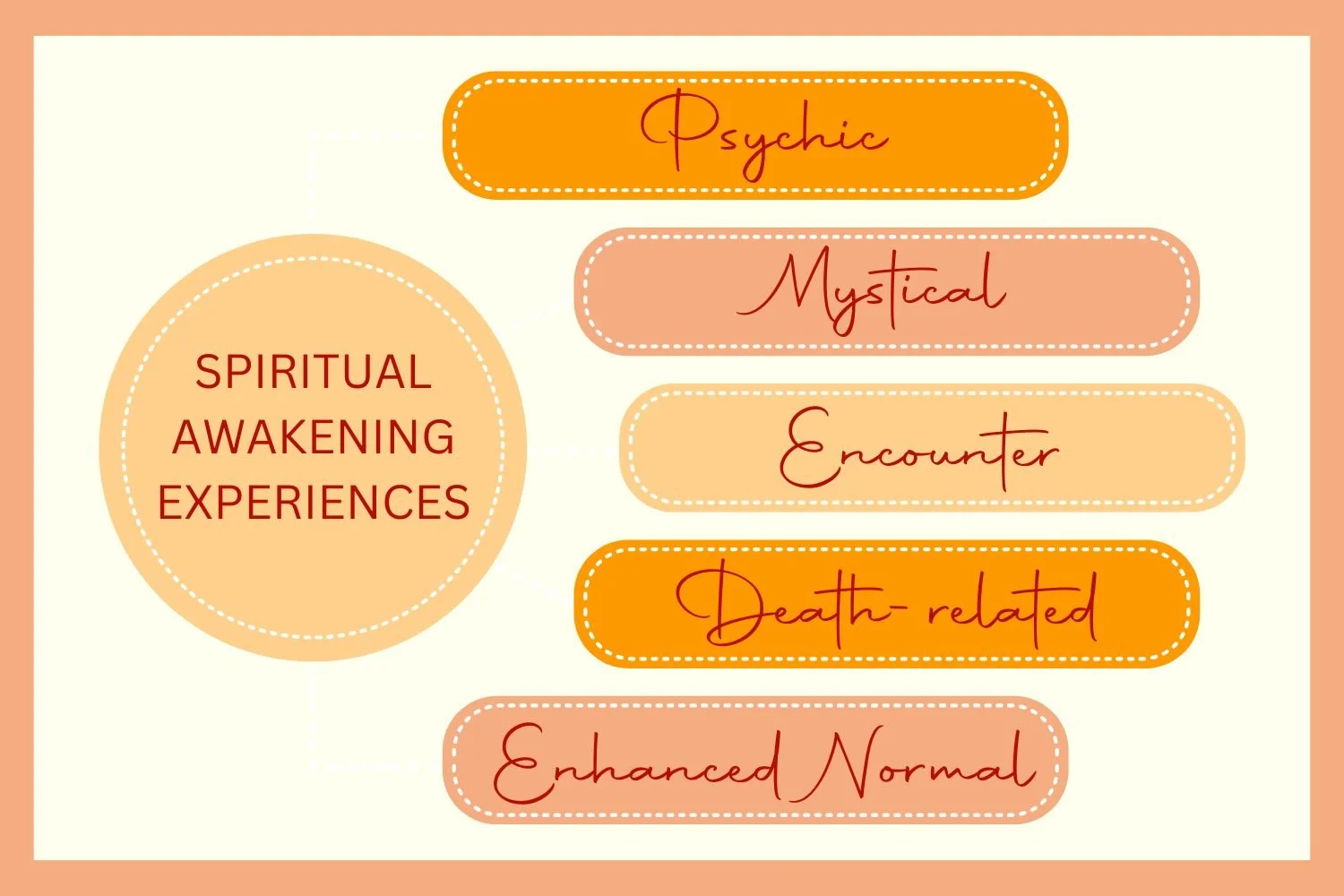
Psychic
Mystical
Encounter
Unusual death-related
Enhanced “normal”
White observed that these exceptional experiences have the potential to change us. If we engage with the experience and proactively integrate it, we are not only transformed by it but are more likely to experience subsequent spiritual experiences. White referred to the experiences that transform us as Exceptional Human Experiences.
Related reading: What Are Exceptional Human Experiences (EHEs)?
Related reading: The Varieties of Spiritual Experience: A Complete Guide
WHAT SPIRITUAL AWAKENING IS NOT
Spiritual awakening is not being able to do the scorpion yoga pose, a destination, an identity, an event, or something we have total control over. There are many misconceptions in the Western world about spirituality and the true meaning of being spiritually awake.
In service to you, I'm hoping this article helps you understand what it means to be spiritually awake, what it's like to be in a spiritual awakening process, and what you can do to support your self-exploration and awakening.

WHAT DOES SPIRITUAL AWAKENING FEEL LIKE?
The awakening journey is a gradual process that is unique to each individual soul, so it feels different for everyone. It also feels very different at different times, depending on where you are and what is arising for you. The spiritual journey is not linear or stable. Often, the spiritual seeker will have profound spiritual experiences that can be felt as positive or negative, leaving them feeling totally ecstatic on the one hand, or excruciatingly depressed on the other. Such experiences include:
Mystical experiences
Non-dual experiences
Ego death
Kundalini awakening
Spiritual crisis
Spiritual death
Dark night of the soul
These different phases of awakening feel very different. And yet, they’re all valid experiences that play important roles in ego transcendence and spiritual awakening. What’s more, we all move through them in our own unique way. How we process, understand, and integrate these experiences will depend on our core beliefs, traumas, values, and mindset.
The important thing to remember is that whether you go through a spiritual high or a spiritual low, these are all just experiences along the path of spiritual transformation; they come, and they go. The key to awakening is not to be attached to any of them or repel them, but to be a witness to them.
Related reading: What Is a Mystical Experience? 7 Science-Backed Signs You’ve Had One
Related reading: Navigating the Dark Night of Soul: Finding Light in Difficult Times
Related reading: Signs of Spiritual Death and How to Reconnect
Related reading: Symptoms of Kundalini Awakening: What to Expect on Your Journey
IS SPIRITUAL AWAKENING A MENTAL HEALTH ISSUE?
Spiritual awakening is not a mental health issue, although it can sometimes feel like it. This developmental process can leave us feeling totally isolated, destabilised, confused, anxious and even depressed.
However, what sometimes feels like a breakdown is, in many cases, a process of re-organisation; a shift in how identity, meaning, and reality are structured and understood. As we awaken spiritually, our egoic identity and the frameworks it's created to maintain its stability are challenged and undermined. This process of adjustment can be difficult, especially after a kundalini awakening or during a dark night of the soul.
Transpersonal psychology sees the spiritual awakening process as a natural unfolding rather than something to “fix.” It is a process where your sense of self, your understanding of meaning, and your experience of reality gradually shift. Understanding awakening as a structured, natural process helps you recognise it, navigate it with clarity, and integrate it into everyday life. This integration leads to a more authentic way of being.
Staying grounded through this process is fundamental to a smoother transformation. Knowing when to pull back, when to seek help, and when to stabilise helps us navigate the process with ease. For example, during intense phases like a kundalini awakening or dark night of the soul, practices such as intense breathwork or psychedelic exploration can be even more destabilising. Careful guidance and grounding are essential to navigate these experiences safely.
If you’re navigating a kundalini awakening, spiritual crisis, or dark night of the soul and want support in making sense of the process, I offer one-to-one sessions. These sessions draw on transpersonal psychology, mindfulness, and spiritual inquiry to help you explore and integrate your experiences safely and meaningfully.
Learn more ➜
HOW DO I KNOW IF I AM SPIRITUALLY AWAKE?
This is a question that can plague us on our spiritual path. As I said, awakening is a process. I like to think that my path, or spiritual awakening process, has been littered with spiritual revelations, followed by a mild mystical experience and then a full-blown, extended mystical experience.
Each revelation led to subtle personal transformation and a deeper meaning of the transcendent spiritual dimension. Each felt like an awakening. But I was never sure if I was awakened or not at this point.
It wasn’t until I had a full-blown extended mystical experience where I experienced universal consciousness and non-duality that I knew I was awake. It's like coming out of the dream of Maya. It's an experience that stays with you for the rest of your life. It's life-changing and gives you a profound sense of your true nature.
At this point, there's no doubt that you are spiritually awake, and there is no question of spiritual awakening stages and symptoms. And yet, the spiritual journey continues. But now, there is a knowing, a knowing of who you are. The question becomes, how do I orient myself here in daily life?
If you’re wondering where you are on your journey to spiritual awakening, I developed a spiritual awakening quiz based on scientific research and theory about the awakening process. It’s a self-reflection tool that helps you understand how spiritually awake you are. Most people find that the results page really resonates and deepens their understanding of their current phase of spiritual awakening. The test is free, no email required, and you can find out more about it by clicking the link.
Related Reading: Spiritual Awakening Quiz: Are You Awakened?
SPIRITUAL TRANSFORMATION
We go through many spiritual transformations along our path of spiritual awakening. Transformation is inevitable as we awaken to deeper truths about ourselves and the nature of reality. While spiritual awakening is a gradual process that continually evolves and unfolds as we awaken to deeper truths, spiritual transformation can be abrupt, profound and life-changing. It is often marked by profound spiritual experiences.
SPIRITUAL TRANSCENDENT EXPERIENCES
At it’s heart, spiritual growth is about transcending the egoic identity. Research suggests that this transcendence is so natural that it often happens in old age without us even trying. The spiritual path is a journey to encourage this natural tendency. And spiritual practices help us in this endeavour.
As we start to engage in spiritual practices like meditation and breathwork, our spiritual awareness develops, and transcendence becomes inevitable. But the biggest leaps in the awakening journey happen through transcendent experiences like non-dual, oneness and mystical experiences.
Suddenly, our understanding of reality is shaken and our spiritual curiosity heightened. We question our prior beliefs and understanding. These profound experiences stop us in our tracks and demand we re-evaluate what we know to be true about ourselves and the world around us, calling into question our very identity.
Ultimately, these transcendent experiences encourage us to transcend our egoic identity. They transform us and orient us back to our true selves, where real, profound inner transformation can be found.
Related reading: What Is Self-Transcendence? The Key to Spiritual Development and Awakening
Related reading: What Is Spiritual Awareness? How to Develop It & Unlock Benefits
PHYSICAL SYMPTOMS OF SPIRITUAL AWAKENING
Not everyone has physical symptoms of spiritual awakening, but it's an important topic for those who do, especially if you’ve had a Kundalini awakening.
Kundalini awakening experiences are often accompanied by intense physical symptoms described as lightning and energy coursing through the body. During these episodes, people experience physical sensations such as involuntary shaking, shivering, throbbing, and pulsating in the physical body. They can also experience nervous system sensitivities, paranormal activity, visual perception anomalies, and intense ego death.
SPIRITUAL AWAKENING SUPPORT
A Kundalini experience can be very challenging to process and sometimes requires expert assistance from practitioners who understand the Kundalini awakening experience. However, it's not easy to find such practitioners. If you are experiencing a Kundalini awakening, dark night of the soul, spiritual crisis or any other challenges, I highly recommend finding a Transpersonal Psychologist to support you through your journey.
Transpersonal Psychologists specialising in spiritual awakening are highly knowledgeable about EHEs, such as Kundalini awakening and other processes and phenomena of the spiritual awakening journey. They have a deep understanding of transpersonal psychology, which is all about the transcendent and transformative spiritual path. As a highly specialised branch of existential psychology, transpersonal psychologists have an in-depth understanding of the broader spectrum of human experience and spiritual growth.
It is their job to support people going through challenging parts of the spiritual awakening process. While they might not have all the answers, they are adept at holding a safe space for you to reflect and learn about what you are experiencing and can support you through most spiritual crises.
If this article resonates with you, and you would like a grounded space to explore any challenges you’re navigating after a spiritual awakening, I offer one-to-one mentoring sessions. These sessions weave together psychology, mindfulness, and spiritual wisdom, helping you integrate and live from your deeper awareness.
Learn more ➜
Related reading: Symptoms of Kundalini Awakening: What to Expect on Your Journey

SPIRITUAL AWAKENING PROCESS
In its broadest sense, spiritual awakening can be seen as a path or a cyclical journey. It's a process. A unique process that shares many similarities with the spiritual paths of other people, but is unique all the same.
As we move deeper and deeper into our true selves, transcend the ego, and expand our spiritual awareness, we each have different challenges and struggles. We each find different ways to overcome the ego's pull and, gradually, transcend the ego's grip, and orient ourselves towards something far greater. Our spiritual states become traits.
Related reading: What Is Self-Transcendence? The Key to Spiritual Development and Awakening
Related reading: What Is Spiritual Awareness? How to Develop It & Unlock Benefits
SPIRITUAL AWAKENING STAGES
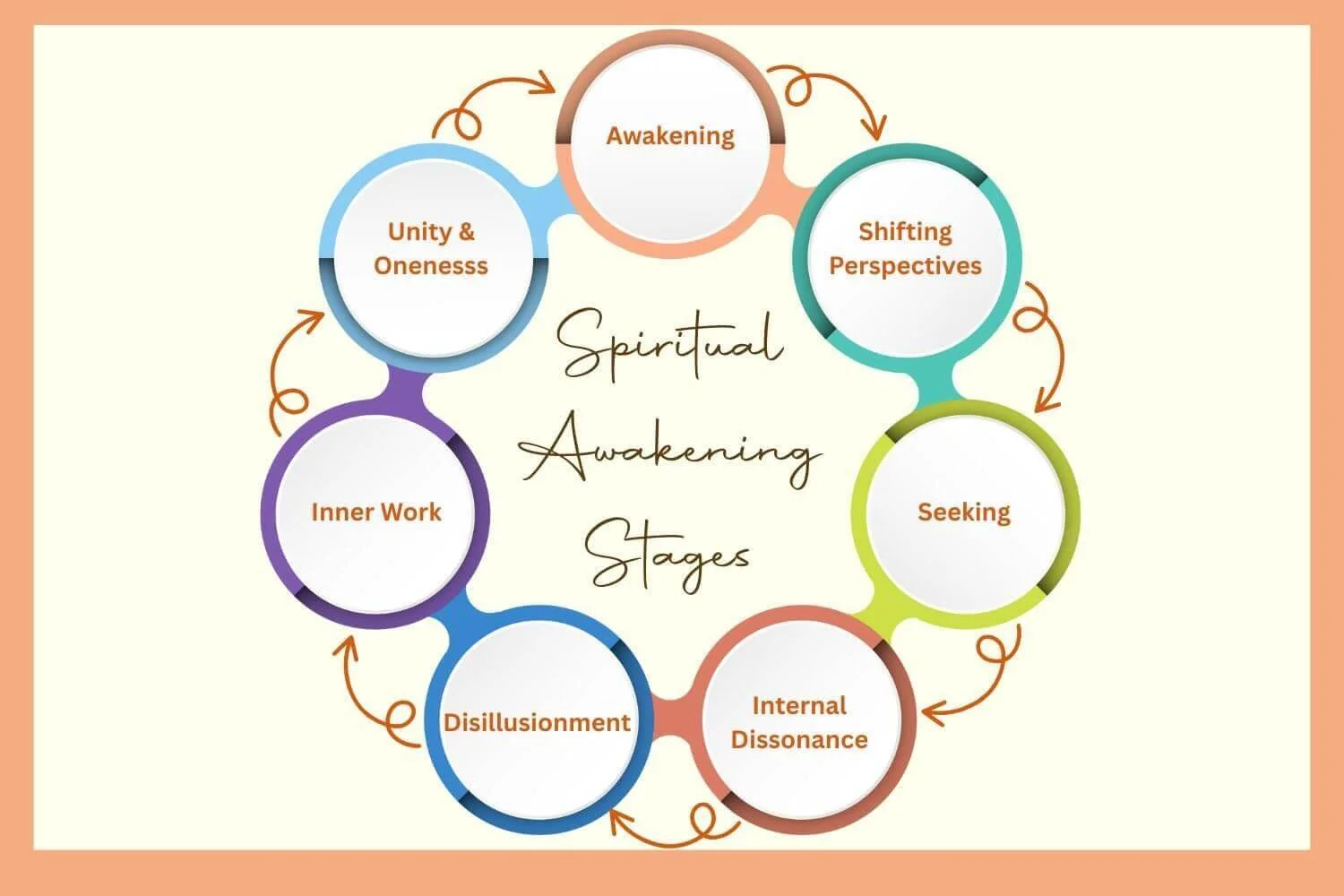
There are many ways to describe the unfolding of awakening. Different traditions use different languages; some speak of three phases, others of ten ox-herding pictures, and some of seven phases. The spiritual awakening framework below integrates ideas from both transpersonal psychology and mystical traditions, and is offered as one way to understand the process experientially.
In reality, the spiritual stages are not distinct spiritual awakening stages and symptoms but dynamic, changing, interchanging, overlapping processes and experiences. We may cycle through them many times, ebbing and flowing with ease or discomfort.
Stage 1 - Awakening
This first stage can start at any time in life. For some, it starts very young; for others, it starts much later. It can be sudden with a powerful spiritual experience or a gradual unfolding.
Either way, the awareness of a spiritual dimension and pure consciousness calls us to reflect, question, and be open to the unknown. You might find that your spiritual curiosity is increasing as you ponder the true nature of reality.
Stage 2 – Shifting perspectives
The increased awareness and more profound sense of the spiritual dimension cause us to shift our perspectives. This, again, can be sudden or gradual. However, a sudden shift in spiritual insights will always require a period of integration.
Our understanding of the world and our belief systems start to change. We may experience heightened awareness and increased empathy, which causes our perspectives to be different from those around us.
Stage 3 - Seeking
This may be the longest stage and can keep us entangled for many years, if not lifetimes. The ego likes to seek. For while it is seeking, it is living, existing, and in command. It seeks that which is within and needs no seeking, and yet we find ourselves seeking even when we have already found what we are looking for. Endless spiritual seeking is a tool of the egoic program.
While seeking is an important part of spiritual awakening, it should not distract us from beingness or living in the present moment.
Stage 4 - Internal dissonance
Once we have truly discovered what we are seeking, we find that we are that, and at the same time, we are not that. We know ourselves to be pure unconditional love, yet we reside within the bounds of the ego, replete with its fears for survival, conditioned programming, and behavioural patterns.
A struggle to reconcile what we know ourselves to be in truth and what we are in reality begins. We yearn to kill the ego and be the unconditional no-self. And once again, the ego takes us on a path of seeking and struggle. We’re lured back into the ego’s stories, moving us further from the truth.
Stage 5 – Disillusionment and feeling lost again
Believing we are different from what we have found. Believing that we have lost what we have found. Believing that we will never get back to what we have found. We become disillusioned with spirit and spiritual awakening. Sometimes, we turn our backs on spirituality and spiritual awakening, distracting ourselves once again in the world of matter and maya.
Stage 6 – Deeper inner work and soul work
If we are wise, we work on our psychological dimension in preparation for that which is true, for we can not hold the light if we can not be trusted with our most basic superpower, our thoughts. This is an invitation to self-inquiry and an exploration of the inner self. While we want to transcend, it is a call for deep psychological work and transformation. A call for integrity and truth. Let inner work be the foundation for you during this important stage.
Stage 7 - Merging into oneness
Finally, so sick of living with and in ego, we surrender into the abyss. We let go of the clutches of what we thought was real and merge into truth. We transcend the ego, and our transcendence becomes more stable.
Stage 8 - Stabilising embodiment and service
The transcending state becomes a trait. Profound inner peace is your perfume. And service to others becomes a cornerstone of our values.
As we cycle through the stages, we find that our perspectives and understanding deepen a little bit more. And the more we see through Maya, the more the ego loses its grip on us. Gradually, after many cycles, we orient ourselves more and more toward something more fundamental within.
FINAL STAGES OF SPIRITUAL AWAKENING
The final stages of spiritual awakening are, I’m sorry to be the one to tell you, another lifelong journey. This time, not of searching and seeking, but one of integration and embodiment. The ego never dies; it is there to keep us alive and, in doing so, will be lurking somewhere in the depths of your psyche, ready to pounce given the opportunity.
You may have exposed its tricks and manoeuvres transcending its grips, but you have not outwitted your ego’s desire for life. And so the final stages of spiritual awakening are integrating your transcendent self and your egoic self. It is to embody that which you have found, your true and fundamental self, your absolute self, even in the most challenging of times.
And also in the most wonderful times. Many highly evolved Gurus trip up here because the ego loves admiration. It loves to be special, important, and powerful, and when you have a large following, the ego’s natural tendency is to grow with it.
And so in the final stages of spiritual awakening we find ourselves on another lifelong journey, not of surrender but of maintaining mastery over our ego.
SPIRITUAL DEVELOPMENT
Transpersonal psychologists have been mapping spiritual awakening for decades. Psychologists such as Ken Wilber, view spiritual awakening as a structured developmental path. Ken Wilber, a leading figure in integral theory, describes it through four key movements: wake up, grow up, clean up, and show up.
Waking up means awakening to your true nature beyond the separate ego, experiencing non-dual awareness, unity, or the transcendent ground of being through meditation, insight, or peak moments.
Growing up means developing psychological and emotional maturity, progressing through stages of development (from egocentric to worldcentric perspectives), and achieving healthy ego functioning, emotional intelligence, and ethical growth.
Cleaning up means addressing and integrating your shadow, the hidden, repressed, or denied parts of yourself (like fears, wounds, or judgments) through shadow work, therapy, or self-inquiry to prevent spiritual bypassing or distortion.
Showing up means embodying your awakening in daily life, expressing compassion, authenticity, and service in relationships, work, and the world.
These four elements together form a complete path: true spiritual development integrates awakening with psychological health, inner healing, and real-world action. They point to the same essential truth: spiritual awakening is an ongoing journey toward wholeness, maturity, and meaningful contribution.
SPIRITUAL ENLIGHTENMENT
So it makes sense that the spiritual life is about spiritual enlightenment, but what does it mean, and is it different from spiritual awakening? (Read more about that here). I stopped using spiritual enlightenment as a concept a while ago. It seems to have so much baggage around it. It seems like an unattainable God-like state. A state of no ego. And it can be a dangerous concept. If we are living in a human body, we have an ego. End of. The human body can not survive without ego.
Instead, I prefer to use the terms liberation or liberated. This simply means being liberated from the clutches of the ego. A liberated person has an ego just like anyone else. And their ego can sit in the driver's seat at any moment; they are not God-like.
However, I consider a liberated person to be someone who has tamed the ego to a large extent. A higher self is more prominent and keeps the ego in check. They are liberated from the trials and tribulations with which the ego is so entwined. But the ego sits, cunningly waiting for its moment, and faced with a unique situation, any liberated person's ego could swoop in and drive the car away!
Related reading: Life After Spiritual Awakening: What Actually Happens and How to Navigate It

PRACTICES TO SUPPORT YOUR SPIRITUAL AWAKENING
There is an abundance of spiritual texts and practices that can help both trigger spiritual awakenings and support you along your path. Remember, don't get caught up in the practice. It's just a tool.
People tend to think of spiritual practices like yoga, tai chi, meditation, and breathwork. These practices have been developed over centuries to help you move forward on your spiritual path and to promote spiritual awareness and self-transcendence. And recently, science has backed up what spiritual traditions have been saying all along.
By looking at the brain when people are doing contemplative practices, researchers have found that changes in neural activity and connectivity are associated with shifts in self-referential thinking, emotional regulation, and a greater sense of connection and well-being; patterns that align with deeper, transformative experiences many describe as part of a spiritual journey.
For example, research shows that practices associated with present-moment awareness and self-transcendence involve changes in brain regions linked to attention, emotional processing, and the sense of self. Weirdly, this growing body of research into the neuroscience of spirituality is throwing up some interesting insights, and it turns out there are some very surprising hobbies that have a very similar effect to spiritual practices, and could even be thought of as spiritual hobbies.
Developing present-moment-self awareness is fundamental to spiritual evolution and awakening. When we can be present to all that is arising in the moment, we can see clearly how the egoic program keeps us locked in to the illusion of Maya. Developing presence is the one thing that has shifted the needle for me most on my spiritual path.
SPIRITUAL AWAKENING AND INNER WORK
For a balanced, authentic awakening, it's essential to balance spiritual and transcendent practices with depth psychological work. Taking this two-pronged inner-work approach will protect you and help you along your journey, making it smoother and faster, but sadly, no less bumpy. While the inner-work approach is challenging, it’s the only route to real, lasting, healthy spiritual transformation.
Diving into our psyche can sometimes be messy, so while I wholeheartedly advocate engaging in depth-psychological and therapy work, try dipping into positive psychology too. Positive psychology helps us on the conscious level by providing great concepts and tools for self-discovery, like discovering our strengths and virtues.
Related reading: Mastering Inner Work: A Practical Guide to Personal Growth and Healing
STAYING IN THE PRESENT MOMENT
Spiritual awakening is really all about orienting ourselves to the present moment. As a transpersonal psychologist who engages in many spiritual practices, I encourage my clients to cultivate mindfulness, self-reflection, present-moment awareness, and presence.
To help them, I run 8-week Mindfulness-Based Stress Reduction (MBSR) programs several times a year. The MBSR is supported by scientific research and validated by studies from reputable institutions. If you would like to learn more about how this program can help, head over to my article, Mindfulness and Spirituality: The Secret Tool on The Spiritual Path
These practices not only help us to orient to the present moment, but they also keep us in check throughout our spiritual awakening. They help keep our feet on the ground and our heads in reality. You can get started straight away with the free Presence Kit, just click the link below.
INTEGRITY
Combine presence and integrity as your spiritual practices, and you've got yourself a powerful framework for navigating spiritual awakening. These may not be the most glamorous or exciting practices, but, in my opinion, they are the most powerful. They are also not the easiest practices, but they are both simple. And they will serve you well on your journey to spiritual awakening.
The spiritual journey takes discipline, courage, determination, and an open heart. And, of all the practices, this combo is the most potent and protective combination for your spiritual awakening journey.
THE POWER OF NATURE
Many people going through spiritual awakening are drawn to the natural world. Research suggests that nature can trigger mystical enlightening experiences. There's something about nature, the stillness, the energy. It can hold us, no matter where we are or what is going on for us. Tap into the power of nature to support you in your spiritual awakening. Spend time in nature.
EXAMPLES OF AWAKENED PEOPLE AND SPIRITUAL TEACHERS
Most spiritually awakened people are humble and would never tell. They have no need to tell the world how spiritual they are. However, some spiritually awakened people do go on to teach and share their wisdom (deepest gratitude to these wise souls), and as a result, some have found themselves in the public eye. There are many amazing spiritual teachers out there, but be warned, there are also many who have done harm.
Here are a few examples of awakened teachers who are either alive or recently passed. I am not recommending any of these teachers; you have to find the ones that resonate with you.
Eckhart Tolle
Mooji
Adyashanti
Thich Nhat Hanh
Ram Dass
Rupert Spira
Tara Brach
Jack Kornfield
Salvadore Poe
Pema Chödrön
PITFALLS ON THE SPIRITUAL PATH
🔶 Getting caught up in the practice
In today's spiritual supermarket, there are so many practices, tools, and experiences to choose from. They're all interesting, fun, and exciting, but I often see people mistake the practice for the destination. People get so caught up in the practice that they forget it's just a tool, like a car. The car is not important. It's just to get you to your destination. In the same way, the practice is not important. It's just to get you somewhere else.
But people are so busy checking out their wheels, fixating on the fancy lights, plugged into the car computer, listening to the radio, they forget to go anywhere. They mistake the mode of transport for the destination instead of seeing it for what it is: a tool. Forgetting what lies ahead, they absorb themselves in the practice and become a master of scorpion.
🔶 Chasing spiritual experiences
I get it! There's an endless variety of spiritual experiences out there, and they’re all wonderful and promote spiritual awakening, but chasing them is just another distraction from what really matters. Research suggests that many people who have had a spiritual experience spend much of their lives trying to get back to that experience - you can’t. It’s in the past and doesn’t exist, and neither does the person who had it; you’ve moved on.
Chasing experiences is the ego’s way to keep you seeking and distracted. Stay focused on beingness, and experiences will come, but don’t go chasing. Be beingness for the sake of beingness, not for heightened spiritual experiences that the ego loves to share.
🔶 Creating a spiritual identity
Close behind, with all the excitement of stepping into their spiritual journey, many people forget it's a journey and think it's an identity. Don't make spirituality your identity. Spiritual fashion doesn't make you more spiritual. Qualities like integrity, honesty, love, and compassion make you more spiritual, not crystals and yurts.
🔶 Spiritual bypassing
Getting all egotistical that you're spiritual and awake, and everyone else is asleep. The most spiritual people I've ever met don't identify with spirituality at all. But many a time, I've seen people touting they're spiritual, and yet they're the first to lie, cheat, steal, and stab you in the back.
Spend as much time on your depth psychology and understanding your emotional body as you do on the yoga mat or meditation cushion. In the long run, spiritual bypassing doesn't serve anyone. Do the work.
So, don't think everyone in your spiritual circles is pure and innocent. A lot of people who have woken up to some extent have not bothered to keep their egos in check, address their inappropriate behaviours, root out their shadows, and deal with their psychological problems. Spiritual bypassing is a real problem in spiritual communities. Do the work!
🔶 Gurus aren't gods - over-reliance on external guidance
There are many fallen gurus in this world who have been bestowed with wisdom and truth, and yet they have tripped up on their ego and shadows and ended up causing great harm and suffering to themselves and those around them. Osho, Bikram Choudhury, and Robert Augustus Masters are examples.
Which brings me to my next point. It's great if you find a teacher that you resonate with, but don't be in a rush and take anyone. It took me about 25 years to find a teacher who touched my soul. And it was so worth the wait. I feel so much gratitude to them now.
But I don't see this teacher as some God-like being. Like everyone else, they inhabit a human body with an ego.
Follow a teacher or a guru, but don't surrender your sovereignty. If they behave in dubious ways, don't overlook it. Many people have suffered tremendous trauma because they gave their guru or teacher a free pass. Be the master of yourself with present-moment self-awareness and integrity. If something doesn't feel right, take time out.

CHALLENGES OF SPIRITUAL AWAKENING
Some people refer to the spiritual path as the path less travelled. And for good reason, it’s not easy. Spiritual development and the spiritual awakening process can be challenging, especially if you experience unexpected and profound spiritual enlightening experiences that undermine your sense of reality and/or identity.
Some common challenges are:
Existential dread
Spiritual crisis
Dark night of the soul
Loss of faith or meaning
Holotropic states
If you experience challenges like a Dark Night of the Soul on the path, remember that it’s a process; whatever challenge you are facing is temporary and will pass. Keep doing your inner work and practices like spiritual journaling. Spend time in nature, do grounding things. Seek out professional support, preferably from a transpersonal psychology practitioner, if you’re not coping.
Related reading: Signs of Spiritual Death and How to Reconnect
Related reading: Navigating the Dark Night of Soul: Finding Light in Difficult Times
SPIRITUAL AWAKENING IS NOT A RACE
If you're in a race, you're in the clutches of ego. Spiritual awakening is about being in the moment, with whatever arises, just as you are. When we can learn this, we are free.
Trust in your own path; know that it is unique, and so is your awakening. It will unfold as it is meant to unfold. Spiritual awakening signs and symptoms will unfold in good time; be at peace with where you are today, for tomorrow might bring challenges.
And know that Grace is on your side.
SPIRITUAL AWAKENINGS ARE GIFTS OF GRACE
You are nothing without Grace. It is by Grace that we awaken. Do what is required of you to keep your ego in check and let Grace do the rest. Be humble, for your ego will want to take any prize it can take for itself. But this is not for the ego.
THE SPIRITUAL AWAKENING JOURNEY
The spiritual awakening process is a spiritual journey. While there will be spiritual awakening signs, there is no real destination. The spiritual awakening stages don't lead you to a definitive place. Instead, the spiritual awakening process is an unfolding back to our true nature and universal consciousness.
Spiritual practices can help us to maintain focus, have spiritual insights and profound realisations, and experience inner transformation, but they can also distract us from our beingness.
Spiritual teachers can lead us to conscious awareness of pure consciousness, but they can also lead us astray and keep us in the seeking loop.
Surrendering to the spiritual awakening process and trusting in the universe is all you really need to do. It is your birthright to awaken fully to your higher consciousness. If that is your deepest desire and you honour that desire, you will awaken to the deepest sense of your true self.


Related Articles to Expand Your Wisdom
Continue your journey with grounded spiritual knowledge and insights from a transpersonal psychologist who has been walking the path for over 30 years. What questions are arising for you now?
What Stage of Spiritual Awakening Am I? Take the Test.
Life After Spiritual Awakening: What Actually Happens and How to Navigate It
Symptoms of Kundalini Awakening: What to Expect on Your Journey

Share this wisdom: