
Spiritual Enlightenment In Real Life
Written by Kirsti Formoso, MSc. Transpersonal Psychology, BSc. Psychology
Everyone wants spiritual enlightenment, but almost no one finds it. Countless seekers have spent years, sometimes entire lifetimes, searching for it. Some catch a glimpse and spend the rest of their lives trying to return. Shrouded in mystery and paradox, this elusive state has become almost mythical. Attainable for the likes of Jesus and Buddha but unattainable for us mere folk.
I'm here to tell you, don't buy into this story. It's rubbish!
I was sold this nonsense for years, but now I believe enlightenment is your birthright. I speak from experience, and I'm not the only one. The greatest teachers across traditions insist it is not reserved for a chosen few. It is our natural state, simply waiting to be recognised.
In this article:
Spiritual enlightenment definition
What different traditions really say about enlightenment
The difference between enlightenment, liberation and spiritual awakening
Spiritual enlightenment experiences
How to recognise spiritual enlightenment in spiritual teachers and gurus
How to know if you are spiritually enlightened
Spiritual enlightenment symptoms
How to achieve spiritual enlightenment
The biggest obstacles to achieving enlightenment
Misconceptions about spiritual enlightenment
Spiritual practices for enlightenment
The ego and spiritual enlightenment
WHAT DOES SPIRITUAL ENLIGHTENMENT MEAN?
Enlightenment is often described as an awakening to the true nature of reality, experienced as a shift into presence and pure consciousness. But to truly understand enlightenment, it is important to recognise that its meaning varies across spiritual paths and traditions. Spiritual enlightenment can mean different things depending on the tradition, culture, or perspective, but at its core, it usually points to presence and a shift in consciousness, a way of perceiving reality and self that is radically different from ordinary, ego-based experience.
ENLIGHTENMENT IN RELIGION, CULTURE, AND TRADITION
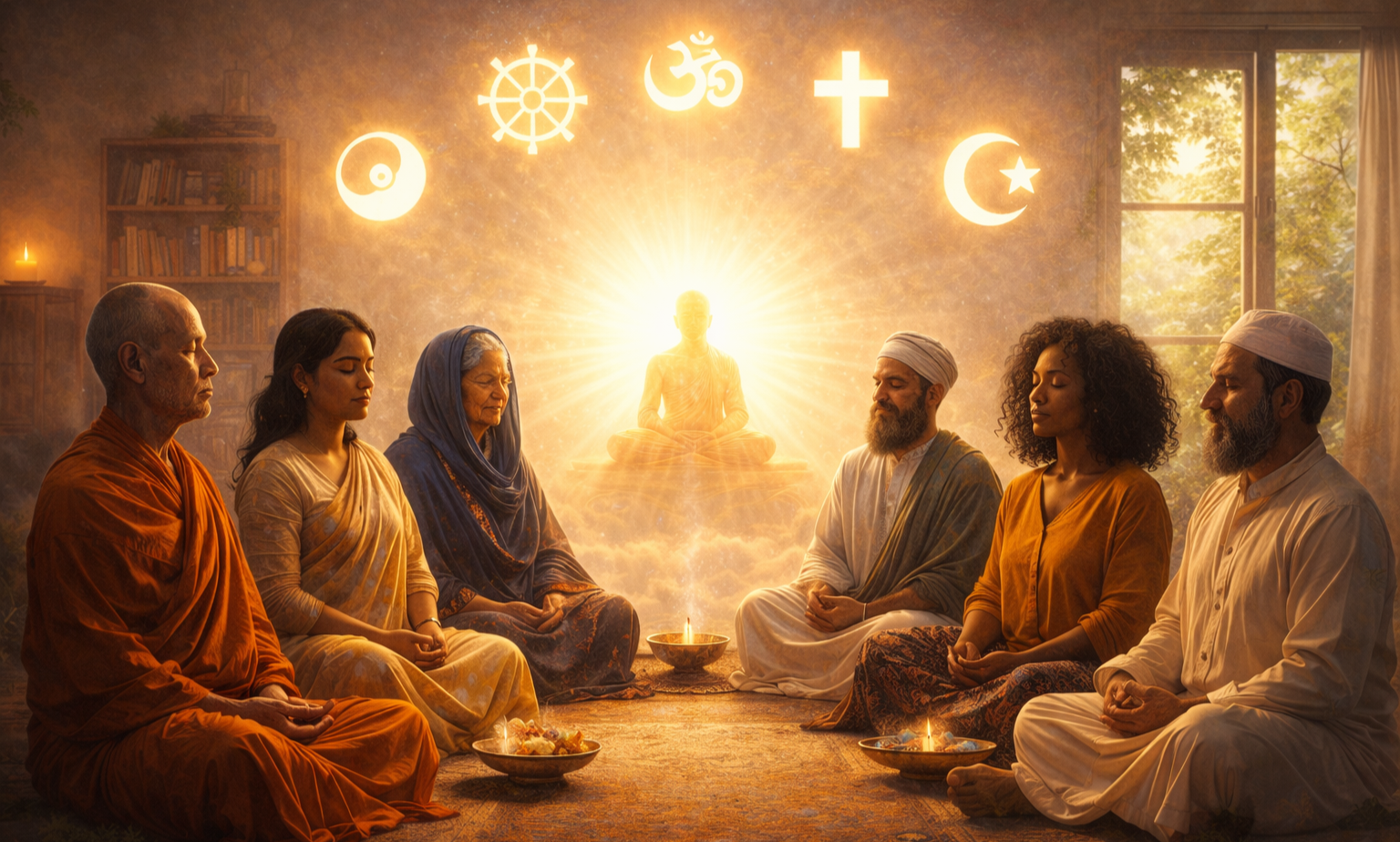
Religion and spiritual traditions offer diverse perspectives on this awakening. In Buddhism, particularly Zen, enlightenment (called Satori or Kensho in Zen) is the direct realisation of one’s true nature, leading to Nirvana, complete freedom from suffering and the cycle of rebirth.
In Advaita Vedanta, enlightenment, or Self-realisation, is the profound recognition that the individual self (Atman) is identical with the ultimate reality (Brahman). It is the dissolution of the illusion of separation.
In Yogic philosophy, enlightenment is the state of Samadhi, a perfect union between the individual consciousness and the divine, where the mind becomes completely still and liberated.
In Christianity, enlightenment is often described as divine union or “the Kingdom of God within,” exemplified in the mystical experience of saints who attained union with God through grace and surrender.
In Taoism, it is expressed as living in complete harmony with the Tao, the natural flow of the universe, free from striving and ego.
Sacred texts and ancient wisdom across these traditions offer valuable guidance and ideas about enlightenment, shaping spiritual understanding for centuries.
Ultimately, the search for enlightenment is often a search for deeper meaning in life, as we seek to uncover our true purpose and the significance of existence.
ENLIGHTENMENT VERSUS LIBERATION
As you can see, most traditions use the terms enlightenment and liberation interchangeably. However, the word “enlightenment” comes with a lot of expectations and misunderstandings. Some people treat it as an unattainable spiritual goal that only a rare few ever achieve. Others imagine that an enlightened being is perfect — incapable of wrongdoing, harm, or ordinary human flaws. I’ve even heard people say that the moment you become enlightened, you basically die or leave your body.
There is some truth in all these ideas, but they are also quite misleading. Many so-called enlightened gurus have caused serious harm to their followers, which shows that the fantasy of instant perfection doesn’t hold up in real life.
Why I Prefer the Term Liberation
Over the years, I’ve found myself using the word liberation far more than enlightenment. It simply carries less baggage, fewer unrealistic expectations, and feels much more achievable.
Liberation means freedom from unnecessary suffering, freedom from the constant grip of the egoic mind, and freedom from the mistaken belief that you are just your body and your thoughts. When you are liberated in this way, you are enlightened to the truth of who you really are. In that sense, you are enlightened, but you are not perfect.
You don’t suddenly become a saint or a god-like being. Your ego is still there, programmed to protect itself at all costs. Undoing and integrating that conditioning takes real effort, time, and honest self-inquiry.
SPIRITUAL ENLIGHTENMENT VERSUS SPIRITUAL AWAKENING
Again, these two terms can be used interchangeably, but they can also mean very different things. Spiritual enlightenment is more of an event, like a mystical experience, that causes spiritual awakening or spiritual transformation. As I said, it liberates us and causes a radical shift in consciousness.
I think of spiritual awakening as more of a gradual process. An unfolding into who you truly are at your essence. To find out more, check out my Definitive Guide to Authentic Spiritual Awakening
Ultimately, the distinction between spiritual enlightenment and awakening often depends on one's personal experience.
IS SPIRITUAL ENLIGHTENMENT PERMANENT?
One of the biggest misconceptions is the idea that once you’re enlightened, you’re enlightened forever, like an on/off switch that stays on permanently. In my experience, it doesn’t work like that. It’s more like a spectrum. It deepens gradually, sometimes in glimpses, sometimes in more stable ways. It’s an ongoing process of awakening, rather than a final, perfect state.
And it's definitely not permanent. Enlightenment is the liberation from the ego, but the egoic tendencies are always there waiting to take over, waiting to take back control. Your egoic program is designed to be in the driving seat, and it will do its utmost to do that by keeping you in the relative world.
So, while in theory enlightenment could be permanent, in reality, the pull of the ego is such that permanent enlightenment is unlikely.
SPIRITUALLY ENLIGHTENING EXPERIENCES
Spiritually enlightening experiences and exceptional human experiences are an important part of the spiritual awakening process. Understanding how to have a mystical experience and taste enlightenment can offer insight into how these states arise and unfold. All these experiences tend to shift our understanding of reality, ourselves, and the world we live in.
These moments often involve shifts in energy and intense feelings, such as love, peace, or even disillusionment, which are integral to the process. If you’re wondering if you’ve had one, check out my articles on Exceptional Human Experiences and The Varieties of Spiritual Experiences.
In transpersonal psychology, classic spiritually enlightening experiences are called mystical experiences. These experiences can be profound. They cut through the habitual ways of perceiving, believing and being. Within the broader field of spiritual psychology and transpersonal growth, they are seen as the doors to enlightenment. They enlighten us, bestowing upon us great wisdom and insight.

WHAT SPIRITUAL ENLIGHTENMENT LOOKS LIKE
No one knows you're spiritually enlightened
Spiritually enlightened people don't walk around with halos on their heads; they don't look any different from the outside. When I had a mystical experience that lasted over a year, the only person who made any comment or seemed to notice was my doctor. It was several years after my experience that she pointed out I was a completely different person than I had been several years ago.
My husband noticed too, and our relationship improved a million times. And a few other people made a few remarks that implied they noticed something about me. But other than that, people aren't really paying that much attention to notice the outward signs.
No doubt, if I'd been suffering from a drug or alcohol addiction beforehand, the outward changes in me would have been far more noticeable. Research suggests that people who suffer from addiction and have spiritually enlightening experiences lose their addiction immediately.
Characteristics of being spiritually enlightened
Remember, spiritual enlightenment is a continuum, not a switch. That means that characteristics are also on a continuum; they’re fluid, changeable and in constant flux.
That said, there are some characteristics associated with spiritual enlightenment. Awakened people tend to have heightened spiritual awareness, improved boundaries, and the capacity for metacognition and holding different perspectives. They tend to be less judgmental, gossipy, and self-critical.
Enlightened people commonly exhibit a profound sense of peace and joy in their lives and express things like kindness, justice, and integrity. For these reasons, people who become enlightened often experience improved relationships with others.
Once enlightened, individuals may feel a disconnection from former beliefs that no longer serve them. Consequently, they can feel disconnected from friends and loved ones, as they now hold radically different perspectives.
I remember when I was living in the mystical state for over a year, I found it really difficult to see why people took issue with so much in their lives. They seemed to have a completely different perspective on things than I did. They were living through their perception and egoic filters rooted in the relative, while I was oriented to the absolute.
Recognising a spiritually enlightened being
So, how do you know if someone is spiritually enlightened? And more importantly, how do you know if a guru or spiritual teacher is enlightened? The problem is, it's not an exact science or a switch that stays on. Someone could portray the characteristics of an enlightened being without being enlightened, and someone who is enlightened could exhibit characteristics I would not associate with being enlightened.
For example, you can be enlightened but still be triggered. Just because you're enlightened doesn't mean you never get triggered ever again in your life. It just means you're more likely to realise quickly that you've been triggered and re-adjust so that emotions do not become projected outwardly.
That said, people who are enlightened can have a certain quality about them. Sometimes, it’s obvious: they are imbued with insight, psychic powers, and noetic wisdom. Sometimes, when you’re in their presence, you can feel your own ground of being more, something sacred or divine and sometimes, you just feel good in their presence; it’s as if their beingness is contagious.
What are the symptoms of spiritual enlightenment?
While we desperately seek enlightenment, for some, it arrives with undesirable symptoms. Along with the bliss and effortless joy, many people have physiological and psychological side effects that can be incredibly challenging to live with.
If you've experienced a kundalini awakening or a true dark night of the soul, you'll know what I'm talking about. Intense enlightenment experiences, often called spiritual crisis, can come unexpectedly and without a sufficient framework for seamless integration.
These intense spiritual awakenings are little understood by traditional psychology and, therefore, by psychiatrists and other mental health providers, so getting adequate and appropriate support can be difficult. In fact, many people are diagnosed with psychosis when they're actually experiencing a spiritual crisis.
If this article resonates with you, and you would like a grounded space to explore any challenges you’re navigating after a spiritual awakening, I offer one-to-one mentoring sessions. These sessions weave together psychology, presence, and spiritual wisdom, helping you integrate and live from your deeper awareness.
Learn more ➜

HOW DO YOU KNOW YOU ARE SPIRITUALLY ENLIGHTENED
This is a question the ego loves to ponder. Because the ego wants to be important and special. So, how do you know? If you’re only just beginning to ask these kinds of questions, you may be at the very start of your spiritual journey and path.
How do I tell if I'm enlightened?
You just know! If you are asking this question, you’re likely a spiritual seeker on the path to enlightenment. It’s very normal to wonder if you’re already there, if you are already enlightened. But if you are seeking, when you become enlightened, you can not miss it. You’re looking out for it. And it’s unmistakable.
Enlightenment is not just an experience, but is meant to signify a profound shift in your understanding of yourself and your place in the world. It's a shift in consciousness.
In fact, in psychedelic research, people rate it as one of the 3 most memorable and profound experiences of their life, in line with getting married and giving birth. It’s so memorable that you will never forget it. And so powerful people spend their whole lives trying to get back to it.
When I had my enlightening experience, it literally rewired my brain. I was no longer the same person that I had been before. It's difficult to miss such an extraordinary event.
Can you be enlightened and not know it?
So, now I’m going to contradict myself! Because I also believe that it is possible for a person to be enlightened spiritually and not even know it. If you’re not a spiritual seeker, on a spiritual journey, you might not recognise your experience as an enlightenment spiritual experience.
I’ve conducted several psychological studies into mystical and enlightening experiences (you can read my research here) using tools like the Mystical Experience Questionnaire, and I have discovered that many people don’t even know they’ve had a mystical experience. They weren’t searching, and they don’t identify as being spiritual, so they just don’t realise it’s a thing, and they don’t have the language to conceptualise their experience. In fact, some people have not realised or understood that what they experienced was actually an enlightenment experience, and may be unsure whether to talk about their mystical experience at all.
THE PATH TO SPIRITUAL ENLIGHTENMENT
Various ancient texts and scriptures describe different spiritual paths and provide insights and guidance on achieving spiritual enlightenment, but the truth is, there are many ways to skin a cat, and everyone’s path will be unique.
Beliefs and ideas from different traditions can shape our journey toward enlightenment, often challenging existing belief systems and offering new perspectives that guide seekers along their unique spiritual path.
For some the path is long, for other’s it is shorter. For some, enlightenment is fleeting, for others, it is more enduring. Whatever route your path takes, honour it, as it is yours and yours alone.
THE SPIRITUAL AWAKENING JOURNEY
Integration is an essential part of the spiritual awakening process. For some, this journey begins after a near-death experience or during an altered state of consciousness, which can trigger profound shifts in awareness. As individuals progress, they often develop a new relationship with the body, seeing it either as a functional organism or recognising its role in the process of awakening, which reflects many of the themes of life after spiritual awakening.
Having a spiritual teacher can provide guidance and access to a community of like-minded individuals. But remember, just because your teacher might be more enlightened than you doesn't mean they are perfect and should be followed or worshipped blindly.
HOW MANY YEARS DOES IT TAKE TO BECOME ENLIGHTENED
The process of spiritual awakening and enlightenment is different for everyone. The time it takes to become enlightened varies, as each person reaches their own point of realisation at a different pace.
For some people, enlightenment comes suddenly and uninvited.
For most people, enlightenment comes after many years of searching and engaging in spiritual practices like yoga and meditation. These people have a deep calling within, beckoning them to discover their true selves. They tend to be less interested in worldly possessions, power, and money and more focused on deep inner work.
WHAT CAUSES SPIRITUAL ENLIGHTENMENT?
While spiritual enlightenment is as elusive as the holy grail for most spiritual seekers, for some, it comes totally unexpected. Either way, the causes of spiritual enlightenment are many and varied. Remember, spiritual enlightenment is not a permanent state but a process and different things will affect how that process unfolds.
Research suggests that there are specific factors that will increase the likelihood of spiritual awakening and enlightenment. The most obvious of these are spiritual practices.
SPIRITUAL PRACTICES FOR ENLIGHTENMENT AND AWAKENING
Spiritual practices and inner work are a fundamental aspect of the spiritual journey. Most spiritual practices are rooted in spiritual disciplines and have been developed over millennia. These practices literally change the brain, making it fertile for mystical experiences and the unfolding of enlightenment.
They all point to living in presence, in the here and now, totally aware and embodied. In this way, they lead to greater knowledge and insight, helping us access divine wisdom and understanding on our path to enlightenment.
Developing present-moment self-awareness is fundamental to waking up fully and experiencing liberation and enlightenment, forming a core aspect of spiritual awareness and its benefits. The easiest way to develop present-moment self-awareness is to practice mindfulness. Incorporating mindfulness exercises into your daily routine can cultivate a deep sense of awareness, foster self-transcendence and enhanced well-being, and improve overall well-being.
Embodied practices like tai chi, yoga, or breathwork are powerful practices that unite the mind with higher states of consciousness, making it fertile for enlightenment experiences.
Neuroscientific research suggests that there are also more surprising spiritual hobbies that support growth and non-dual experiences, making our brains more receptive to spiritually enlightening experiences.
And of course, there are some famous cases where psychedelic mystical experiences taken with the right intentions have opened the door to enlightenment. The current psychedelic renaissance relies heavily on the therapeutic effects of mystical experiences for its therapeutic advances.
OVERCOMING EGO AND EMOTIONAL ATTACHMENTS
Overcoming ego and emotional attachments is a crucial step on the path to spiritual enlightenment. Killing the ego is not the answer; the ego, in this context, is the part of us that clings to a separate self, our personal identity, stories, and the roles we play in everyday life. While the ego can help us navigate the world, it often creates a sense of division between ourselves and others and can cloud our understanding of our true nature.
As you deepen your spiritual practices, such as meditation and yoga, you begin to develop a heightened awareness of your thoughts, emotions, and habitual patterns. This awareness is the key to recognising when the ego is in control, shaping your reality and keeping you stuck in old beliefs or emotional attachments. Through consistent practice, you can start to observe these patterns without judgment, allowing them to loosen their grip.
THE EGO AND SPIRITUAL ENLIGHTENMENT
Letting go of the ego’s influence doesn’t mean losing your sense of self; it means seeing beyond the surface, understanding that your true nature is far more expansive than any label or story. As you release emotional attachments and the need to identify with every passing thought or feeling, you open yourself to a deeper sense of freedom and inner peace. This process is at the heart of spiritual enlightenment, helping you experience reality as it truly is, rather than through the filters of ego and attachment.
Ultimately, overcoming ego and emotional attachments is not about denying your humanity, but about embracing a more profound sense of connection with yourself, others, and the universe. And yet for many people, experiencing enlightenment is rapidly followed by a sense of disconnection as the persuasive ego steps in to regain control. The strength of the ego’s determination in it’s endeavour can ultimately result in a dark night of the soul.
If you’ve drifted far from that connection, recognising the signs of spiritual death and how to reconnect can be an important part of this journey. It’s a journey of returning to your pure consciousness, where you can experience life with greater clarity, compassion, and understanding.
ENLIGHTENMENT AND SPIRITUAL BYPASSING
Enlightenment is at once the eg’s biggest fear and its greatest desire. Enlightenment, being the holy grail of spirituality, means that if you find it, your ego will take it for its own, to feel important, prove it is special, and gain power. All the things the ego loves. This is the biggest pitfall after enlightenment and the most dangerous form of spiritual bypassing. And it’s something to look out for in yourself and your spiritual teachers and gurus.
INSIGHT HIGHLIGHT
Spiritual enlightenment is a state of heightened awareness and profound inner peace. It is often described as an awakening to the true nature of reality, experienced as a shift to pure consciousness. It may involve recognising oneself as pure consciousness and the dissolution of the sense of self as an individual. Spiritual enlightenment is often viewed as the realisation of unity with existence, dissolving the belief in a separate self.
It is available to you. If you find it, honour it, don’t give it to your ego.


Related Articles to Expand Your Wisdom
Continue your journey with grounded spiritual knowledge and insights from a transpersonal psychologist who has been walking the path for over 30 years. What questions are arising for you now?
Understanding Spiritual Bypassing and Why It’s Harmful (With Examples)
Dark Night of the Soul? Meaning, Signs, and How to Navigate It
Symptoms of Kundalini Awakening: What to Expect on Your Journey

Share this page: